How to Make Wedding Table Programs That Look Effortless
Table programs are the quiet detail that makes a wedding feel considered — but most couples either skip them or spend a week agonizing over the font. Here's how to make yours in an afternoon, with real examples you can copy.
TL;DR — Key takeaways
- A table program is a one-page timeline of your wedding evening — what happens, when it happens, and where to go. Not a schedule for the couple, a guide for the guests.
- Keep it to five to eight items, one per line, with a time or a simple order. If a guest can't read the whole thing in ten seconds, it's too long.
- Name the moments by what guests experience, not what you're doing: 'First dance' not 'we're going to dance,' 'Grandmother's toast' not 'my mom's speech.'
- Skip the small print, the thank-yous, and the couple's story — that's the job of the toasts and the website, not the card on the table.
- Print them a week before and lay one per place setting. The five minutes you spend setting them out buys you a reception that flows without you announcing every next step.
The detail you notice the whole night
You’ll never catch a guest commenting on the table program. That’s the point. It’s the invisible thing that tells them the evening has a shape — that there’s a rhythm to the night, that dinner comes before the cake, that the toasts aren’t a surprise ambush at 10 pm. The room relaxes. The host gets to stop narrating.
And yet it’s one of the most fiddly small details in the whole reception. It’s small enough to be ignored, big enough to look like an afterthought if it’s done badly. I’ve sat at a wedding where the program was a single page of cramped text in three different fonts — and I’ve sat at one where it was two lines on a beautiful card and I remembered it a year later.
You don’t need a designer for the second kind. You need a system, and about an hour.
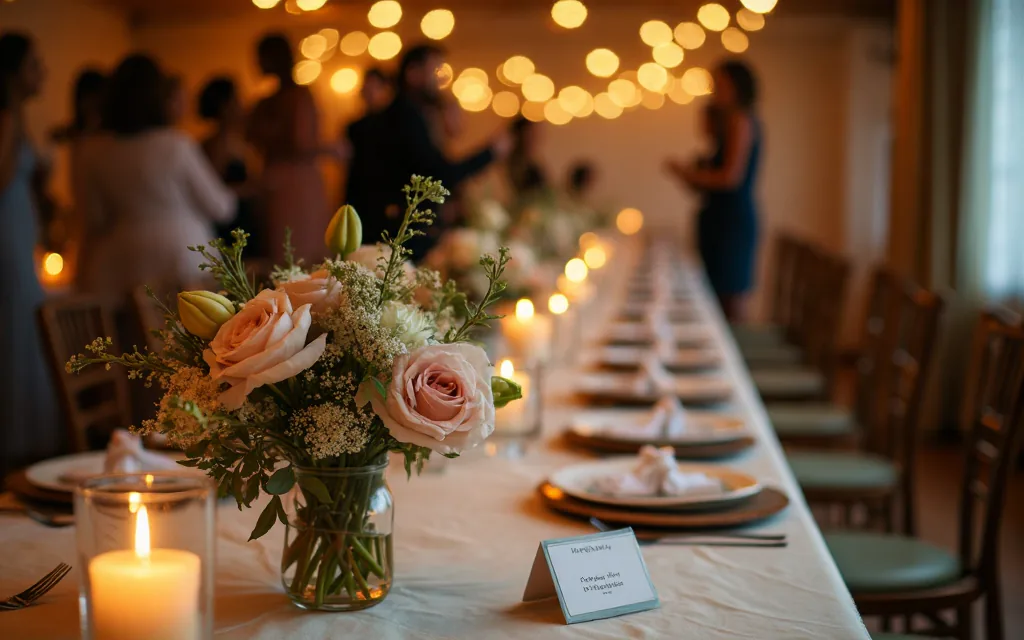
What wedding table programs actually are
A table program is a one-page timeline of your wedding evening, written for the people sitting at the tables — not the couple, not the photographer, not the venue coordinator. It answers three questions a guest has, usually without asking them:
- What’s happening next?
- When will I actually eat?
- When should I stand up?
That’s it. If your program answers anything else, it’s doing the job of a different document. The venue’s run-of-show has the times, the vendor contacts, the lighting cues. The website has the couple’s story. The program has the evening, in the order guests experience it.
Keeping that scope tight is the whole trick. Every detail you add — the song lyrics, the thank-you to the florist, the reading of the ring inscription — is a line a guest has to skip, and skipped lines make the card look cluttered even when it isn’t.
The content: five to eight lines, no more
Here’s a real example for a 120-guest wedding with a six-hour reception. Five items, one per line, no times, no small print:
Cocktail hour — Garden terrace The first dance Dinner — Served at each table Toasts and cake Last dance — 11:30
That’s the whole card. Read it again — ten seconds, maybe less. A guest at table six now knows that dinner is a served course (not a buffet they need to crowd), that the toasts come after (so they can relax through dessert), and that the evening has a clear ending.
If your evening has more than eight moments, group them. “Dinner and toasts” counts as one. “Cocktail hour and welcome” counts as one. You’re not losing anything by grouping — you’re just telling the room the shape of the night rather than its minute-by-minute script.
Name the moments by what guests experience. “First dance” not “we’re going to dance.” “Grandmother’s toast” not “my mom’s speech.” “Cocktail hour” not “people wait for the room.” The program is the guest’s guide, so it should be written in the guest’s voice — even though you’re the one writing it.
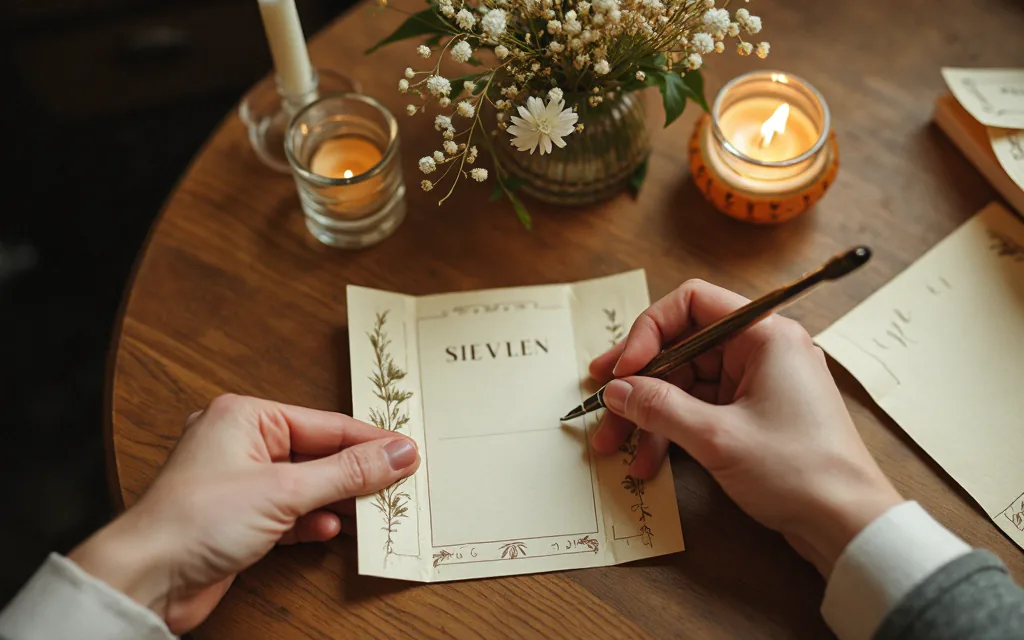
Times, or no times?
Most weddings don’t need times on the program. A top-to-bottom order reads more like a celebration and less like a meeting agenda. Times make sense when:
- Your reception runs long or crosses a venue change. “Dinner at 7, last dance at 11:30” gives the room a rhythm without listing every item.
- You have a formal dinner service. Guests appreciate knowing when the first course arrives — it’s the one moment where the room is quiet and everyone’s looking at the card.
- You’re hosting a multi-event day. If the ceremony and reception are an hour apart, a single anchor time (“Reception begins at 6”) saves you a hundred “when does dinner start?” questions from well-meaning aunts.
For everything else, skip the clock. The program is a guide, not a contract. A guest who sees “Toasts and cake” with no time will still stand up when the room does — and they’ll thank you later for not making the evening feel scheduled.
The look: three rules that do 90% of the work
You don’t need a designer. You need three decisions, made once:
One typeface. A single serif — something with a little character but not a script — at 10 to 12 points. The double-font, small-caps, italic-and-regular look you see on most template sites is the first thing that makes a program look like a template. One font, one size, done.
Generous line spacing. Double the space between lines. This is the single biggest visual upgrade and it costs nothing. A card with five lines and room to breathe looks like it was made by someone who cares; the same five lines packed tight looks like a receipt.
A smaller card than you think. A5 (148×210 mm) or slightly smaller, folded once if you like the formality. The smaller the card and the more white space around the text, the more expensive it looks. A full-page program with a border and a monogram at the bottom reads as a newsletter. A small card with five lines reads as an invitation.
Cream or off-white paper on a dark tablecloth photographs better than white on white — the card becomes part of the table’s color story instead of a blank sheet. And leave the corners or the bottom edge unprinted. That white border is the elegance.
A simple layout template you can copy
Here’s the exact structure that works for almost any wedding. Five lines, no header, no footer:
[Line 1: The start] — Cocktail hour · Garden terrace [Line 2: The entrance] — The first dance [Line 3: The meal] — Dinner · Served at each table [Line 4: The toasts] — Toasts and cake [Line 5: The send-off] — Last dance · 11:30
A few variations by occasion:
- Formal black-tie: add times to lines 3 and 5. Keep the other three clean.
- Casual backyard: cut to four lines. Skip the cocktail hour if you’re serving drinks at the table.
- Two-venue evening (ceremony at the church, reception at the barn): make line 1 “Reception at the barn · 6 pm” so the transition is explicit.
- No dinner (reception only): drop line 3 and add “Cake and toasts” in its place. The structure holds.
The pattern is always the same: start, entrance, meal, toasts, send-off. If your evening follows that arc, you already have your program — you just need to write it down.
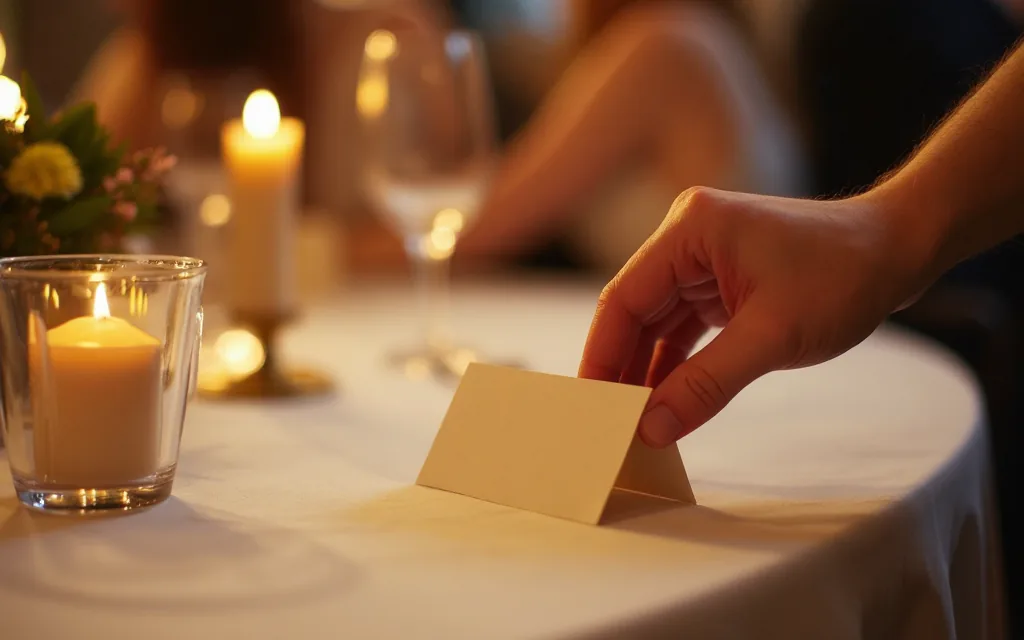
Printing and laying them out on the day
Print a week before, not the morning of. A batch of 40–150 small cards is cheap at any print shop, and a week’s buffer means a smudged batch or a font glitch doesn’t become a 4 pm panic. Order 10% extra — they get bumped, dropped, and lost at the tables, and you’ll want spares for the head table.
Lay one per place setting. Not one per table, not one at the entrance — one in front of every guest. Set them below the napkin or beside the water glass, at the moment the tables are dressed. It’s a ten-minute task with a couple of helpers and it’s the difference between a room that feels prepared and a room that feels improvised.
Match the programs to the tables. If your venue is doing assigned seating, print the head table’s program slightly differently (a monogram, a different paper) so the couple’s table looks intentional. If you’re not doing assigned seating, identical cards for every table is the move — simpler, cheaper, and no one notices.
Keep the spares in a pocket. The couple, the best man, the venue coordinator — whoever is walking the room that night should have three spare programs in a pocket. A card gets flipped, a guest gets added at the last minute, a table is moved. The pocket solves it without a second trip to the car.
The quiet win: a room that flows
Here’s what actually changes when the program works. The first time the band asks “what’s next?” and the room just knows — dinner, then toasts, then cake — the host’s shoulders drop. You’re not the narrator of your own wedding. You’re a guest at your own celebration, eating, drinking, and being surprised by the toast you didn’t expect.
That’s the whole job of the table program. It’s not a decoration. It’s the quiet infrastructure of a reception that flows — the thing that tells a room of 100 strangers they can trust the evening, even if they don’t know the couple’s plan.
And it’s the kind of detail guests notice more than you do. They won’t say “great program.” They’ll say “that was such a smooth night,” and you’ll know exactly which small card on the table helped get them there.
One last thought
Planning a wedding means holding a lot of small details in your head — the guest list, the seating, the budget, the timeline, the vendors, the cake, the flowers, the programs, the toasts. The thing that makes it overwhelming isn’t any one task; it’s that they’re all tangled together in different places. A spreadsheet for the budget, a group chat for the toasts, a napkin sketch for the seating, a memory of what the florist said last week.
Keeping the whole thing in one place — the guest list with RSVPs, the budget with charts, the timeline, a drag-and-drop seating plan, and a clean PDF you can hand to the venue — means you can actually think about the programs instead of just worrying about them. A good planning tool turns the evening’s run-of-show into a document you can export, print, and trust, without reassembling it from three different notes apps at 6 pm the day before.
If you’re looking for a tool that holds all of this in one place and works on your iPhone without needing an account or internet access, Event Stories is free on the App Store with no account required and works offline. It covers guest lists with RSVP tracking, budget charts, a timeline you can export to your calendar, a drag-and-drop seating planner, and a professional PDF you can share with your venue — including the evening’s order of events, ready to print as table programs.
Free on the App Store · No account required · Works offline.
Frequently asked questions
What should a wedding table program include?
The order of your reception evening, written as a guest sees it: cocktail hour, the entrance, the first dance, dinner, toasts, cake, and the send-off. Five to eight lines is the sweet spot. Include times only if the evening is formal or long — for most weddings, a simple top-to-bottom order reads easier than a clock.
How many items should be on a wedding table program?
Aim for five to eight. Fewer than five and it's just a list of two things; more than eight and guests stop reading after the first line. If your evening has more than eight moments, group them: 'Dinner and toasts' counts as one. The test is simple — a guest should be able to read the whole card in ten seconds while their water is being refilled.
Should a table program include times or just the order of events?
Just the order, for most weddings. Times feel rigid and start to look like a corporate agenda — the last thing a celebration needs. If your reception runs long or you have two venues, add a gentle anchor: 'Dinner at 7' gives guests a rhythm without micromanaging them. The program is a guide, not a contract.
What should NOT be on a wedding table program?
The thank-you notes, the couple's love story, song lyrics, and any text in a font smaller than 10pt. Those belong in the toasts, the website, and the keepsake box — not on a card that's being read while the chicken is being served. If you can't read the card from an arm's length in the candlelight, shrink the text or cut the content.
How do I make table programs look elegant without a designer?
Three rules do 90% of the work: one typeface, generous line spacing, and a smaller card than you think. A single serif font at 10–12pt with double spacing looks expensive next to the double-font, cramped, justified block that trips most templates up. Cream or off-white paper on a dark tablecloth photographs better than white on white. And leave the corners or edges unprinted — the white border is the elegance.
Where do I put the table programs on the day?
One per place setting, laid just below the napkin or beside the water glass. If your venue is doing assigned seating, match each program to its table when you print so the head table gets the right one first. A single copy on the head table is fine for small weddings, but guests always appreciate the one in front of them — it's the moment the room goes quiet and everyone actually reads the evening.
Should table programs match the seating chart or be identical for every table?
Identical for every table, unless a specific table has a unique moment — say the grandparents' table has a family photo to be displayed. Programs are the evening's timeline, not the table's identity. That's what the seating chart is for. One master program, printed in a batch, laid out by table — simpler, cheaper, and less to think about on the day.